Broadcast - 30 November 2025
Last club room technical night Bill VK7MX, brought in and talked us through three items designed and built by BluQRP. As the last part of the name implies they are all designed for QRP operation and as for the blue, the only thing I can think of is that all the printed circuit boards used are very blue in colour.
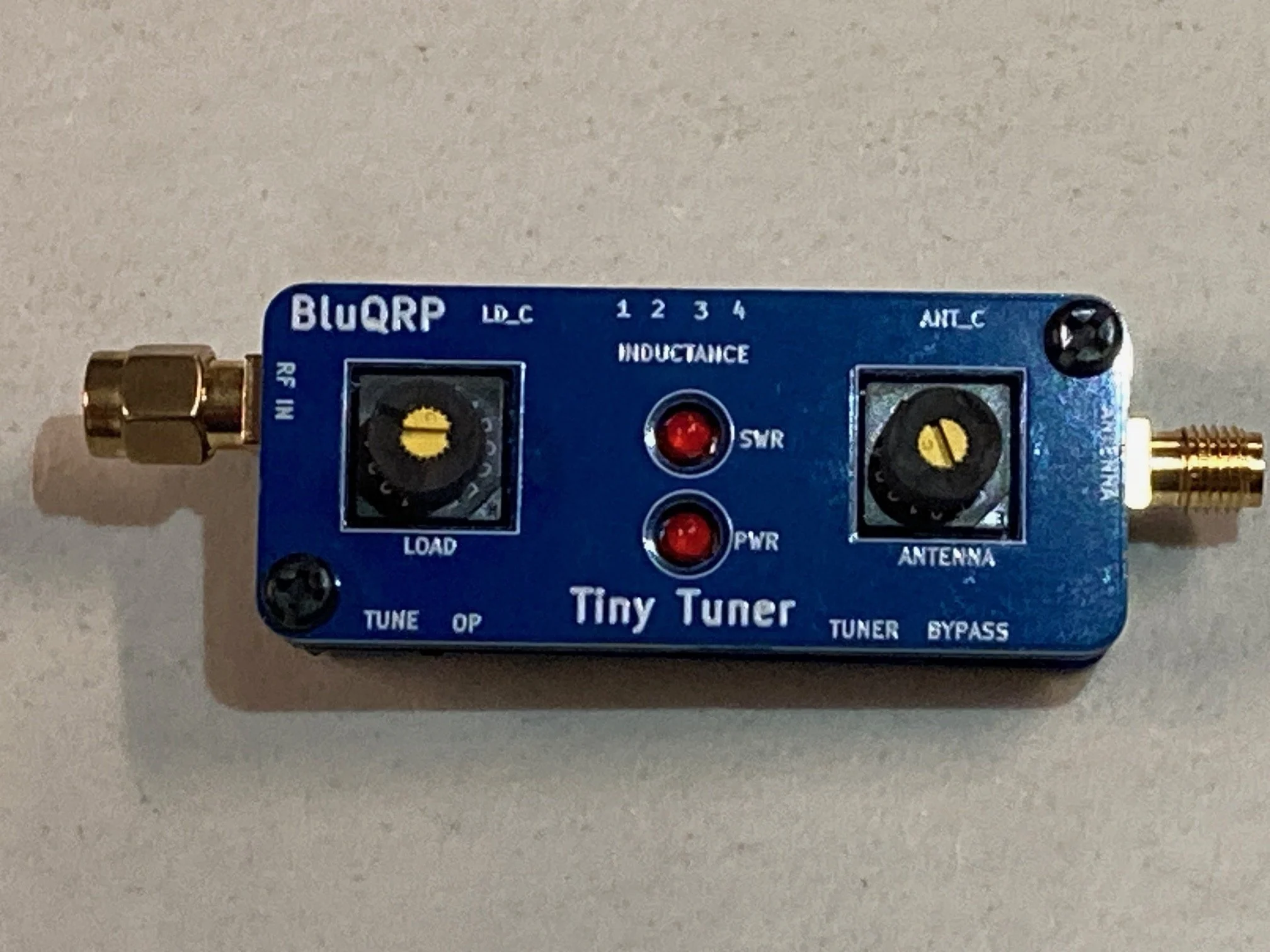
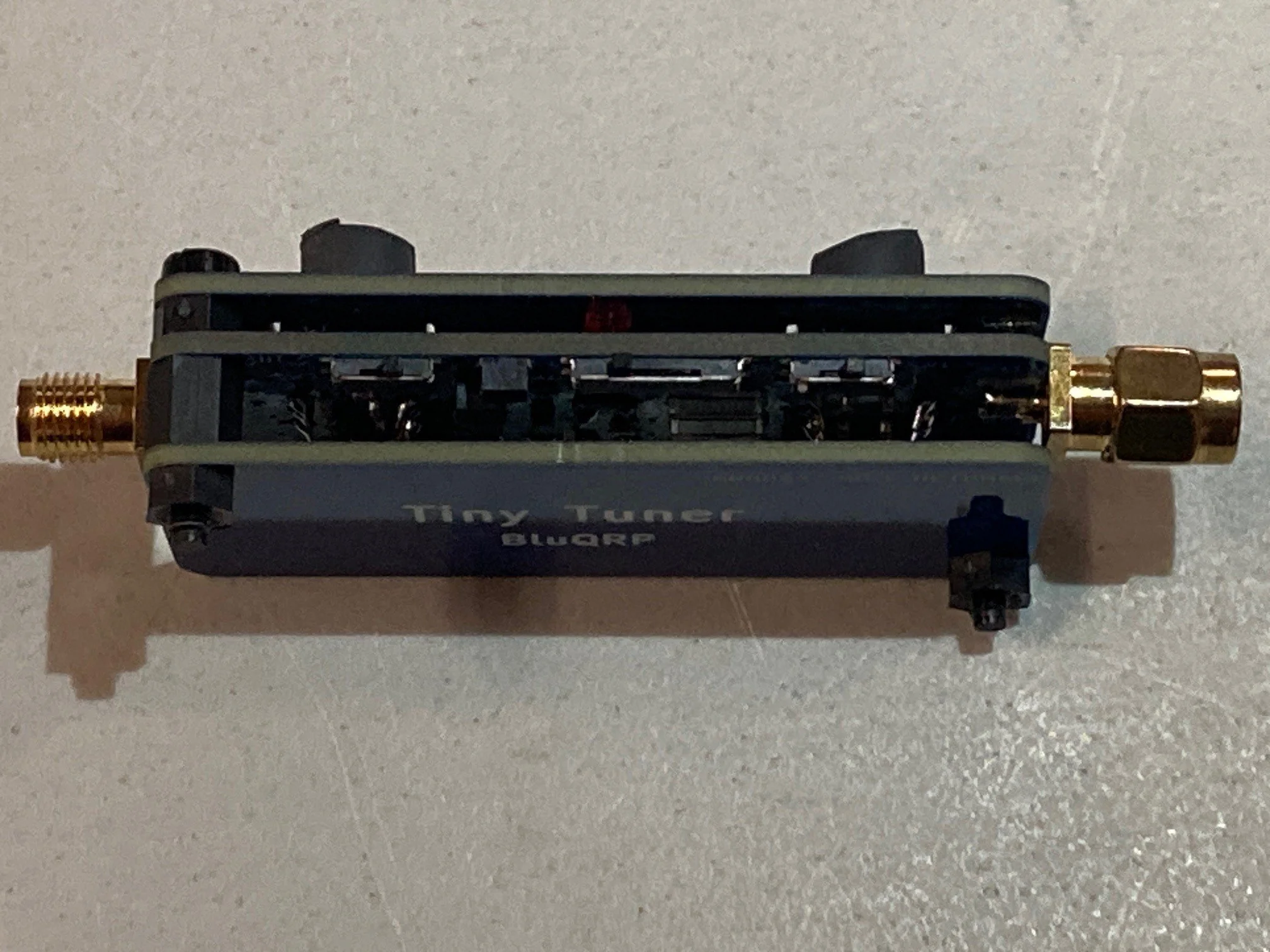
Firstly Bill had a device going by the name “Tiny Tuner”, and it is an incredibly cute little antenna matcher, it is about the length of a credit card, possibly two thirds the width and about 15 mm thick! This is the newer and smaller version of the previous “Pocket Tuner” by BluQRP that was almost as large as a credit card, which really isn’t very big anyway. These are specifically designed for QRPp use, the second lower case “p” denoting that it is meant to be operated at less than 1 watt of RF through put. Just for information QRP followed by lower case “pp” denotes less than 100 milli-watt throughput! It uses two BCD encoder rotary switches for Load and Antenna capacitance selection and a four position slider switch to select the inductor value giving the T-Matcher good coverage of popular HF bands. The matcher front panel has a Light Emitting Diode to denote power on, with another showing a relative SWR indication. There is also the inclusion of a slider switch for unit bypass. Small lengths of rubberised tubing are provided to push over the BCD encoder shafts so you can obtain a proper grip on them when turn rather than having to rely on a screw driver. The main printed circuit board is sandwiched between a front and rear PCB for protection. Check out the NTARC website pictures for size and remember that the connectors are indeed SMA. This tiny antenna matcher would be ideally suited for Portable, SOTA and POTA operations.
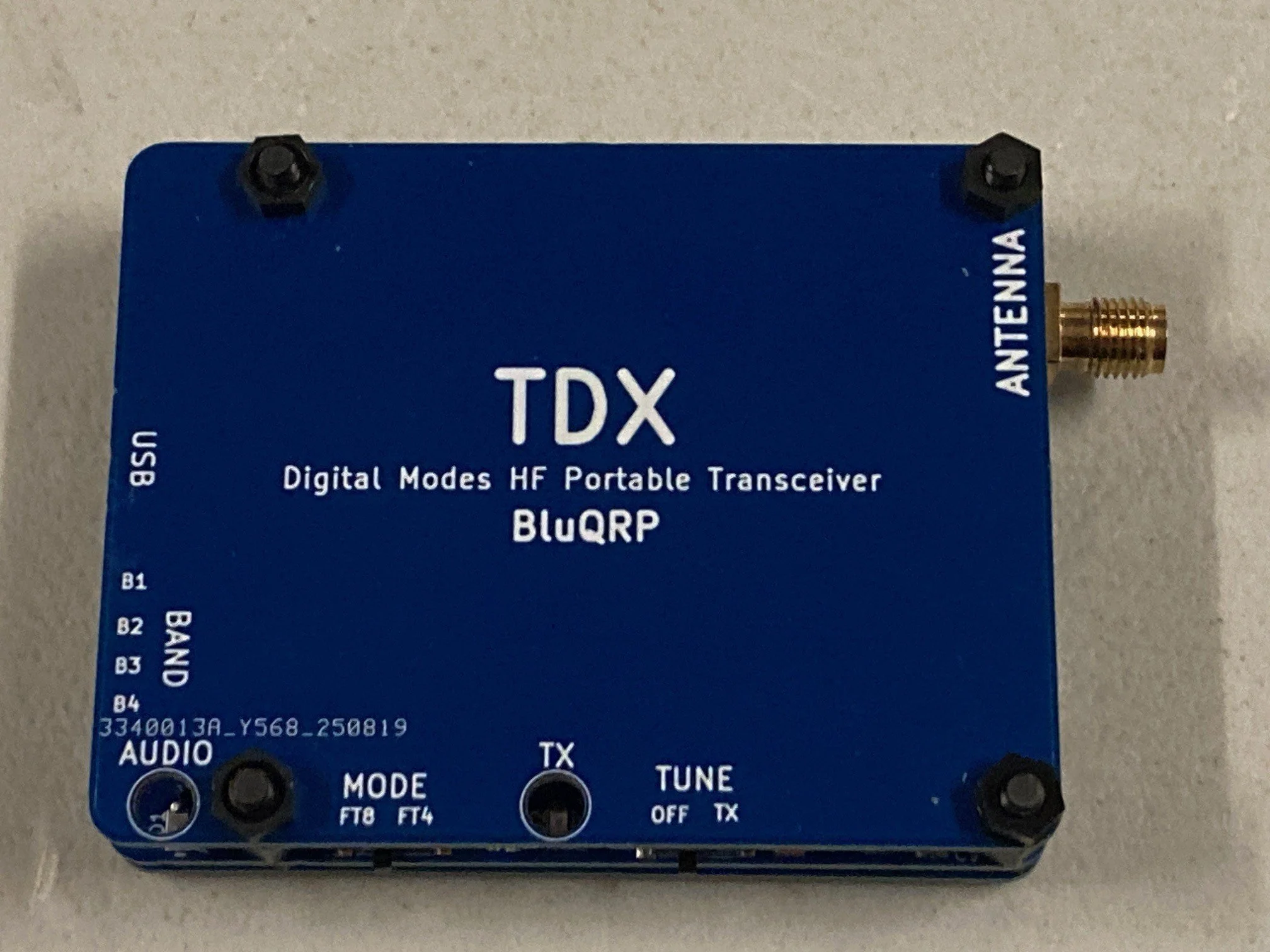
The second BluQRP device Bill had with him was a TDX Digital Modes HF Transceiver, once again very small as it would be close to the size of a deck of cards. Think of this one being the RF outboard module that plugs into your Smart Phone via USB connection. The Smart Phone hosts the software app and provides all the processing power required to decode and encode the FT8 and FT4. The output power of the module is about an eighth of a watt. The module has a SMA antenna socket, a slider switch to select one of its four HF bands, an FT8 or FT4 mode selector switch, a tune switch and a transmit indication LED. And yes the module is also very blue.
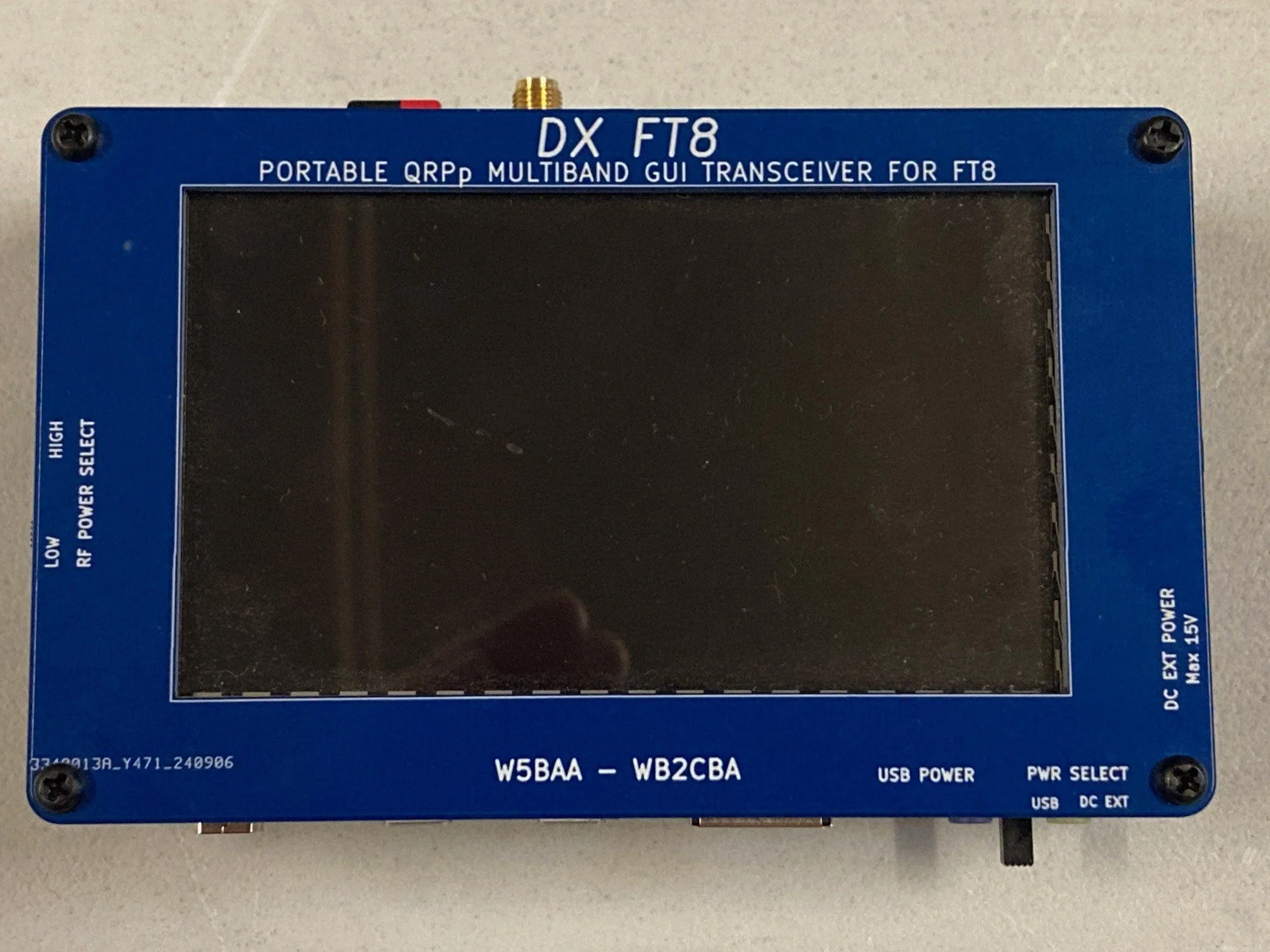
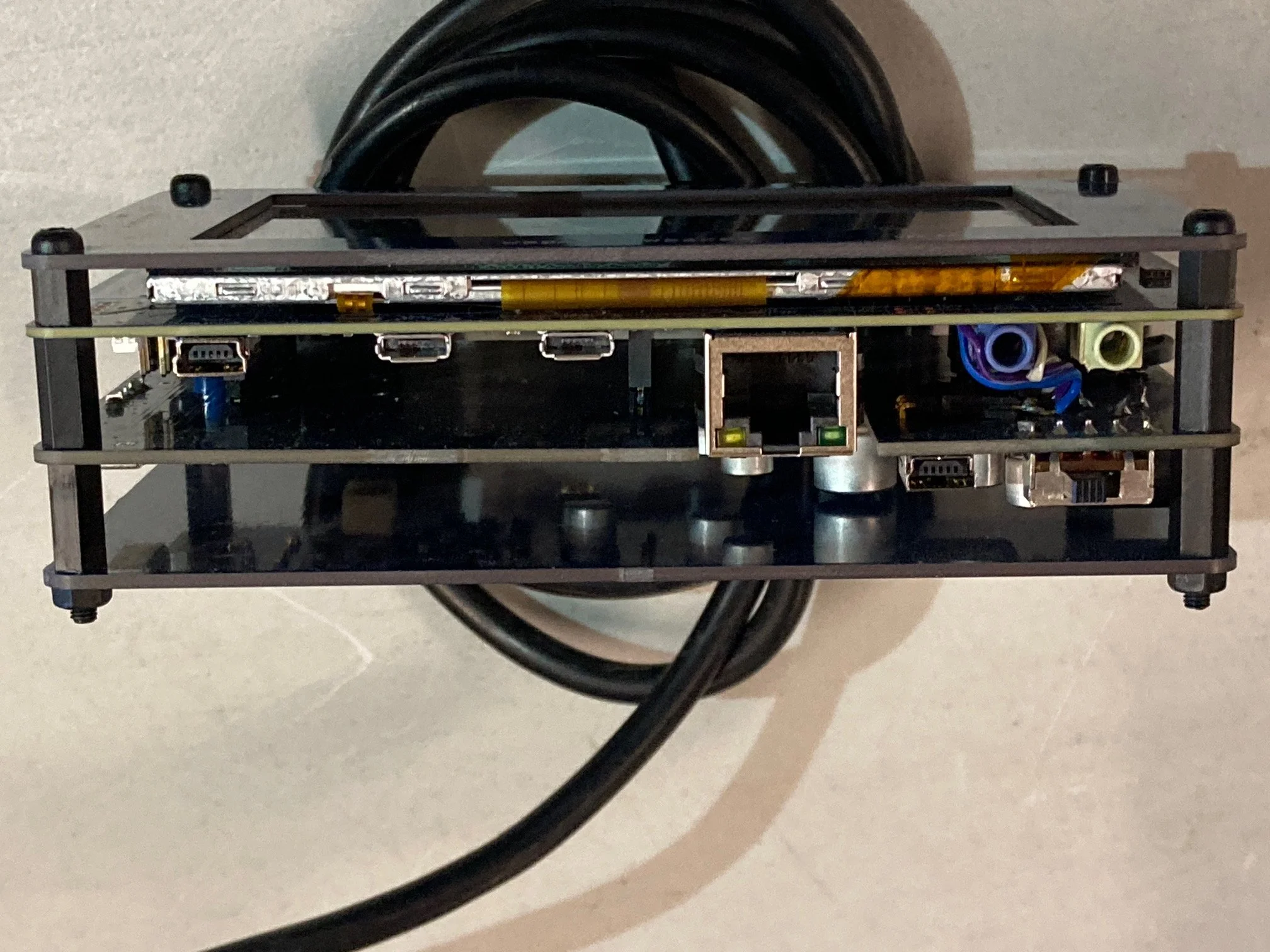
The third BluQRP device Bill had with him was the stand alone DX FT8, which is an abbreviation for Digital Xceiver for FT8. The DX FT8 Transceiver project is the result of an open source collaboration between Charley Hill, W5BAA and Barb Asuroglu, WB2CBA to create a standalone FT8 Tablet Transceiver. The heart of their design is a transceiver RF board which in turn piggy backs onto an industry available ST Micro Evaluation board based on the ARM Cortex STM32F746 microcontroller and is called the “DISCO”. The evaluation micro provides processing power for the GUI or Graphical User Interface which is presented to the user on a 109 mm RGB 480×272 pixel colour LCD-TFT capacitive touch screen. With the inclusion of a front and back panel you have a stack of four boards, this method of fast and cost effective presentation is proving to be a very common construction system nowadays. There is a 5 or 7 band HF version available depending on your requirements. The unit comes with an internal battery charger regardless of the internal battery option being taken up. The transceiver has a Low or High RF power output slide switch on the side of the unit. This selects between 231mW or 445mW on the 10m band progressively increasing in power up to 372mW or 844mW on the 40m band. Antenna connections are once again via SMA connectors. The DX FT8 Transceiver can operate either from 5V USB power bank or any 1000mA capacity USB power source or by using the DC barrel connector can be powered from 7V to 15V external power supply. A power supply source can be selected with DC Power Select slide switch located on the side of the Transceiver. The result is a very portable stand-alone transceiver for working multiple bands in FT8 digital mode all packed into one small unit. No longer do you need to carry a PC or a laptop or tablet for GUI interface operation for FT8 with a classic transceiver. I would imagine this alone would make it appealing for smaller and lighter setups when backpacking for SOTA or POTA activations or as a travel transceiver with FT8.
According to Bill, don‘t order any BluQRP units at the moment as the new American tariffs have made things somewhat prohibitive, luckily his order was squeezed through before the implementation. Thanks for sharing these three very blue pieces of QRPp equipment with us as well as the tip to save money.
This is the final reminder for the NTARC Christmas dinner that is now only a few days away, this Thursday the 4th of December, 6 pm for a 6:30 order placement. This year we are trialling a change from the usual Wednesday to the Thursday evening as this may be more manageable for members. Due to popular requests it will be held at the Iron Horse Bar and Grill located at 468 Westbury Rd, Prospect Vale. There is still time to register, just notify one of the committee members or the secretary at: secretary@ntarc.net before midday Thursday.
As always pictures will be available on the NTARC Web site under “Blogs” for this broadcast. NTARC Blogs
UPCOMING EVENTS
On Air Test and Technical Net session - Every Wednesday, Test-Net and CW course on 3.580 MHz from 7 pm, then a Technical Net on 3.567 MHz from 7.30 pm till 8.30 pm. Your host for the evening is Nic VK7WW.
NTARC General Meeting - Wednesday the 10th December at 7:30 pm, NTARC club rooms.
Coffee Morning - Held every Friday in the NTARC Club rooms. Time is from 10 am to noon.
Finally – If you have any items of news please email them to the Secretary at the following address news@ntarc.net all items to be received no later than 5 pm on the Friday prior to the Broadcast.
That’s all folks,
73, Stefan VK7ZSB.