Broadcast - 8 March 2026
Our last club room technical night was mainly devoted to the Vector Network Analyser or VNA, and concentrated on using them in the port 1 to port 2 or “through” testing mode.
Although the VNAs that Colin VK7ZCF and Lionel VK7ZLB brought in weren’t the original nano‑style units with their small 75 mm screens, the 175 mm displays they had were still compact as a field-units. In a group instructional situation an even larger display is advantageous.
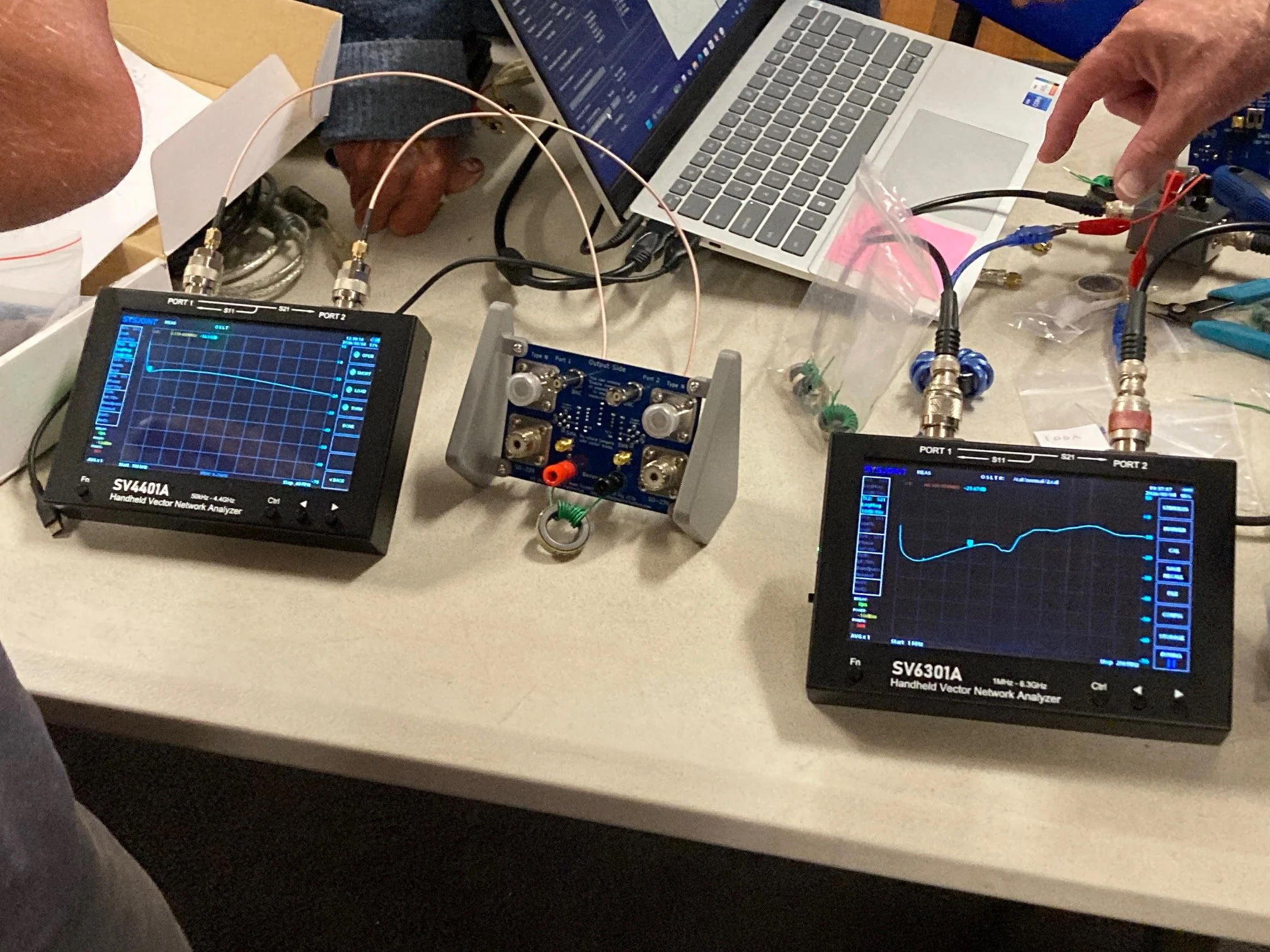
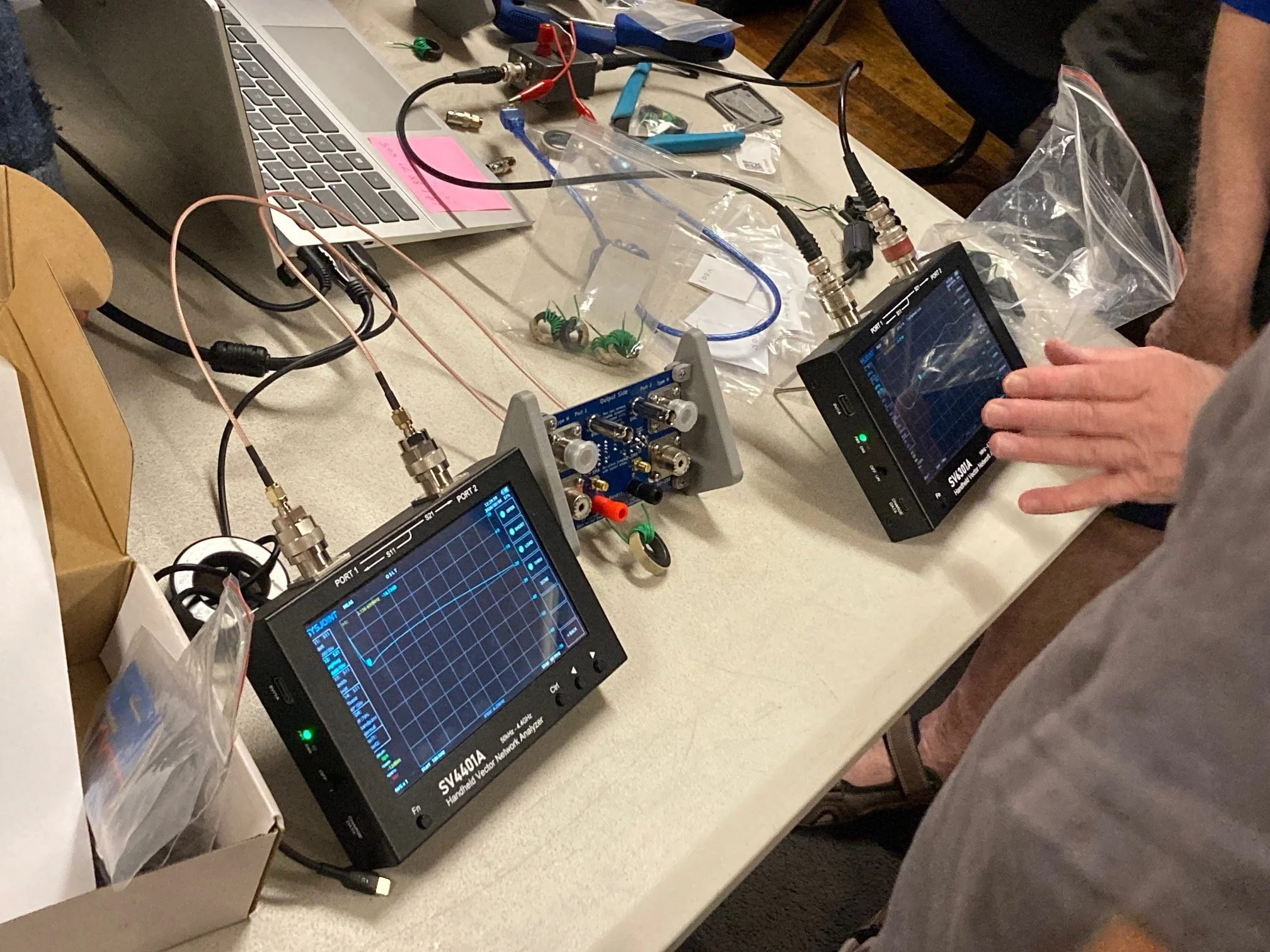
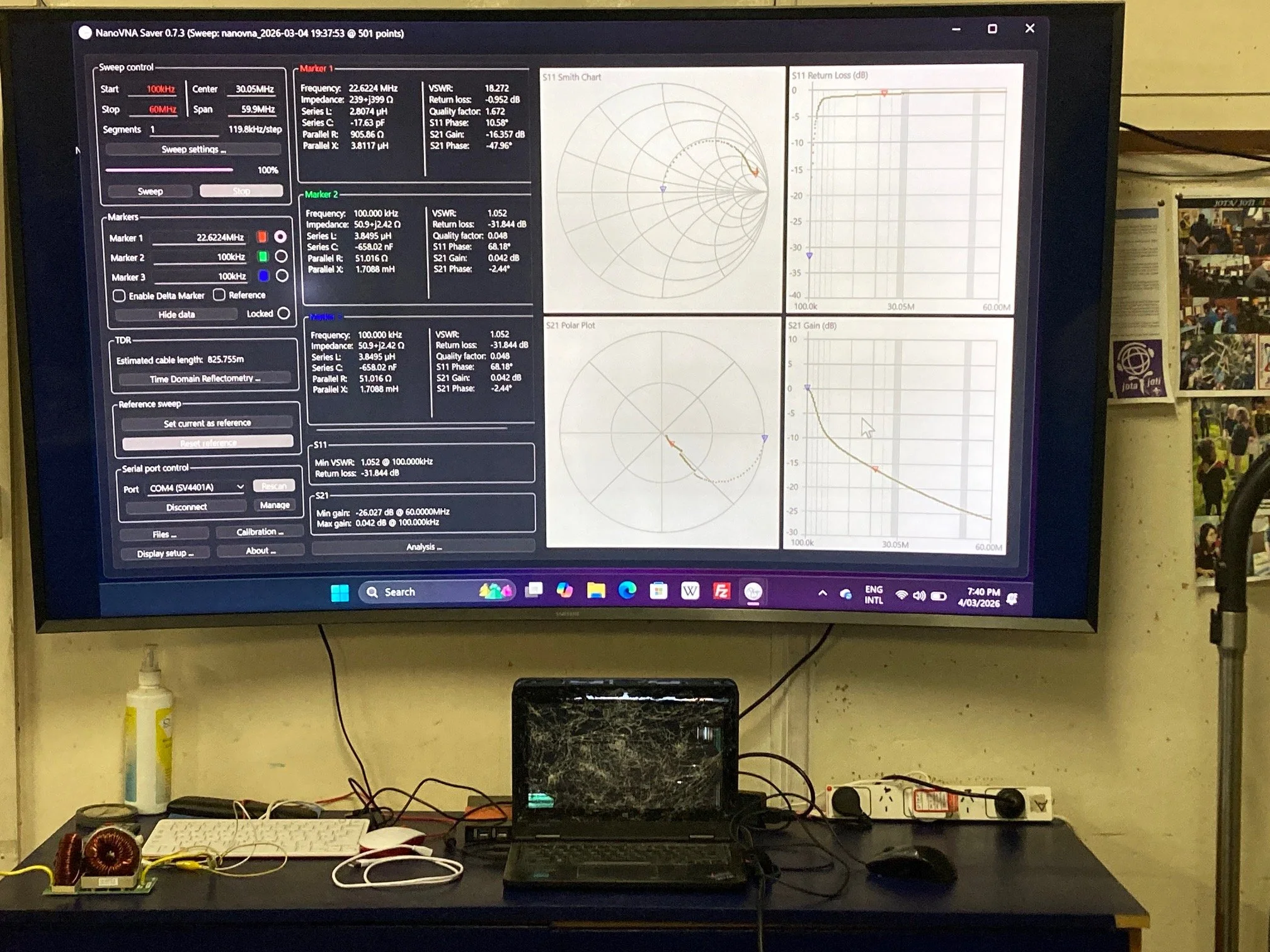
This is where Andre’ VK7ZAB, made a big impression, he had pre-installed the “nanoVNA Saver” software on a laptop specifically for the remote control of these VNAs via USB. This allowed access to all menu items that are normally available on the VNA and displayed all numerical and graphical results. The laptop intern was connected to the large screen wall monitor in the main club room. This allowed for easy visibility of the VNA’s display and its generated smith charts and attenuation graphs. Settings and changes made on the field device were also mimicked back onto the laptop and vice versa. The demonstrations took place with a pair of SYSJOINT, Handheld VNAs, one a SV4401A and the other a SV6301A, usable to 4.4 GHz and 6.3 GHz respectively.
Colin brought along his recently purchased test jigs from Halibut Electronics in California, used for the test and measurement of Common Mode Current Choke effectiveness.
Colin concentrated mainly on co-axial and screened cables and the effect on attenuation versus frequency of the cable passing once or multiple loops through toroidal and clip on ferrite cores.
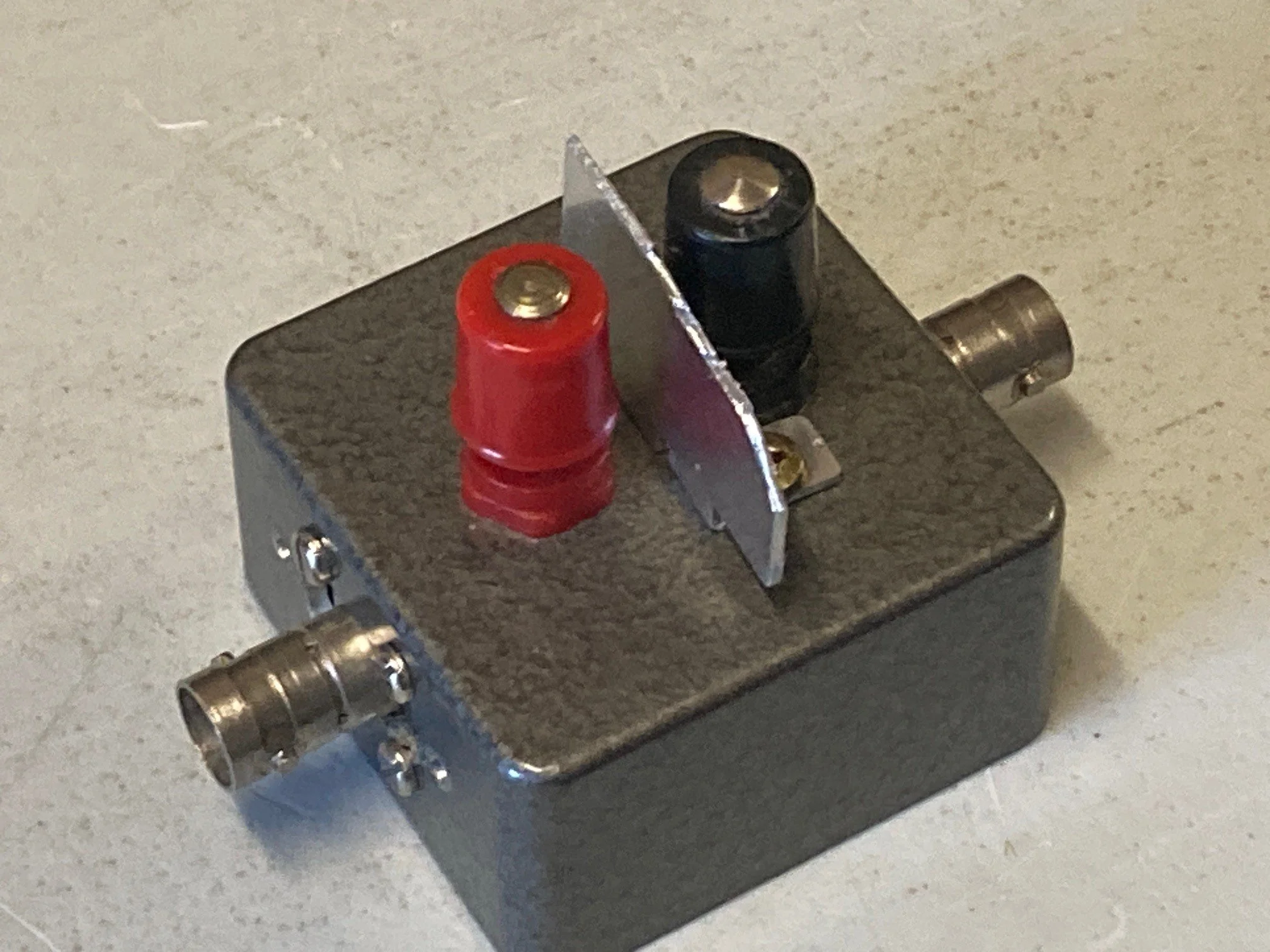
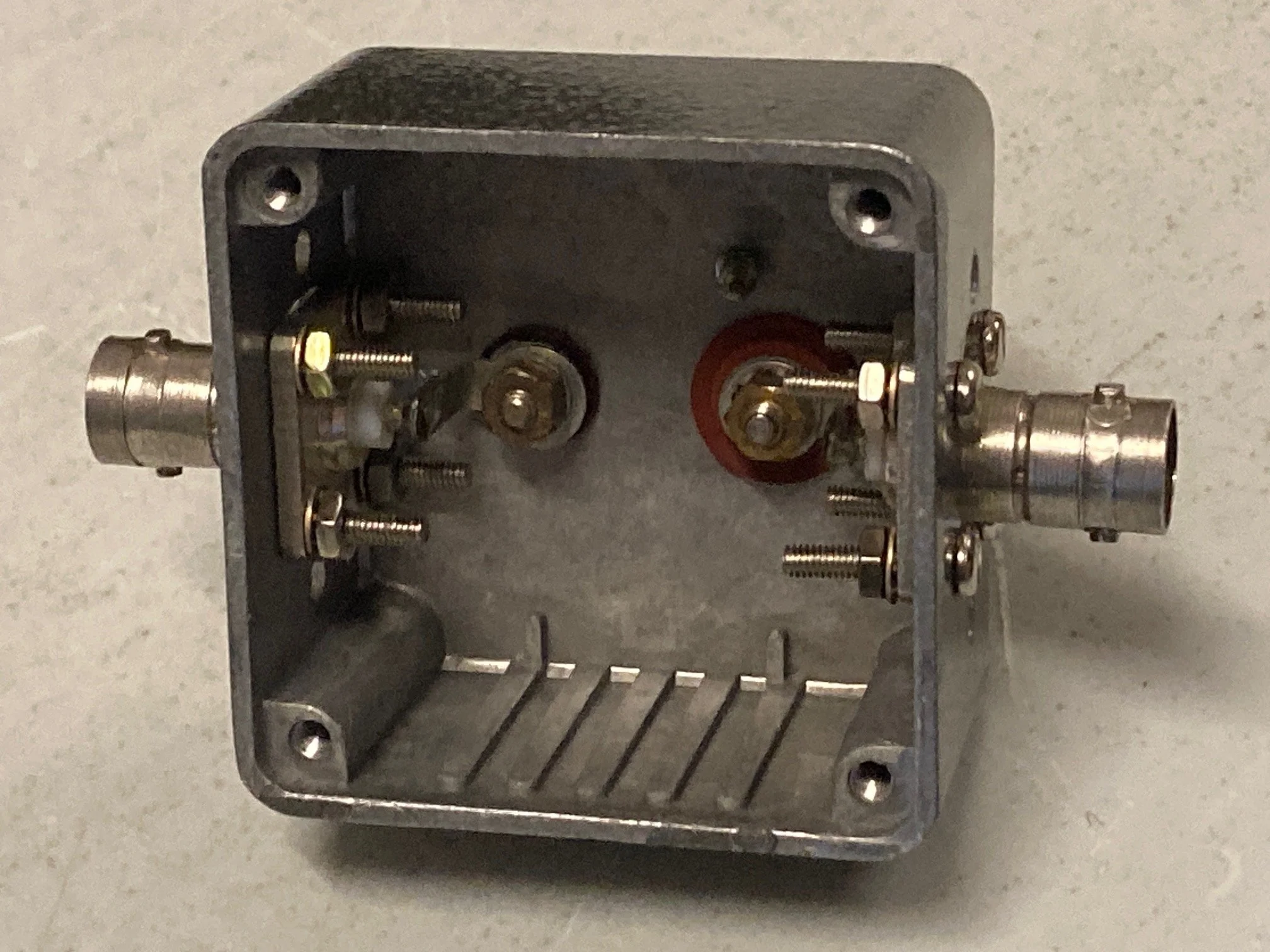
Lionel VK7ZLB, used his self-designed and constructed test jig to measure parameters of various electronic components. The test jig was constructed in a small die cast enclosure about 50 mm square, with a BNC socket on opposite sides that allowed for external patching to port 1 and port 2 on the VNA for “through” measurements. On the top of the enclosure are two push down binder posts, each connected to one BNC socket internally. The item under test is inserted between the two binder posts.
After the initial obligatory VNA menu test calibration Lionel then went on to verify the calibration. This was achieved by individually testing a set of precision resistors, confirming that the measured impedance values matched those predicted by the relevant formula.
Also on the test jig, to improve isolation, was a detachable aluminium shield located between the component binder post clamps. Lionel included this to minimise any cross coupling between posts. At HF all looked fine without the shield but once you start testing towards the Gigahertz part of the spectrum it become very evident as to why he included the shield. The binder posts being about 30 mm tall, start to become significant radiating elements in their own right and progressively become part of the overall item under test.
After many, many, many toroids and turn combinations later the take home is:
In general, increasing the number of turns or adding more ferrite material improves the effectiveness of a common‑mode choke….. up to a point. However, the usual caveats apply: just as adding additional ferrites eventually reaches diminishing returns, increasing the number of turns introduces greater inter‑winding capacitance. This added capacitance can shift or create unwanted resonances, limiting the choke’s performance and complicating the overall response.
The main take home is as always, “Test and Measurement” so you are not flying blind.
As usual pictures will be available on the NTARC Web site under “Blogs” for this broadcast. NTARC Blogs
For more choke set-ups see the SSTV photos for Thursday.
UPCOMING EVENTS
On Air Test and Technical Net session - Every Wednesday night, Test-Net and CW course on 3.580 MHz from 7 pm, then a Technical Net on 3.567 MHz from 7.30 pm till 8.30 pm. Your host for the evening is Nic, VK7WW.
Club Room Technical night - The next session will be Wednesday the 18th March and will commence at the usual time of 6.30 pm at the Club Room Archer Street, Rocherlea.
Coffee Morning - Held every Friday in the NTARC Club rooms. Time is from 10 am to noon.
Finally - If you have any items of news please email them to the Secretary at the following address news@ntarc.net all items to be received no later than 5 pm on the Friday prior to the Broadcast.
That’s all folks,
73, Stefan VK7ZSB.