Broadcast - 24 May 2026
Last technical night, following the REAST presentation, a few items still managed to make it in for a quick show-and-tell.
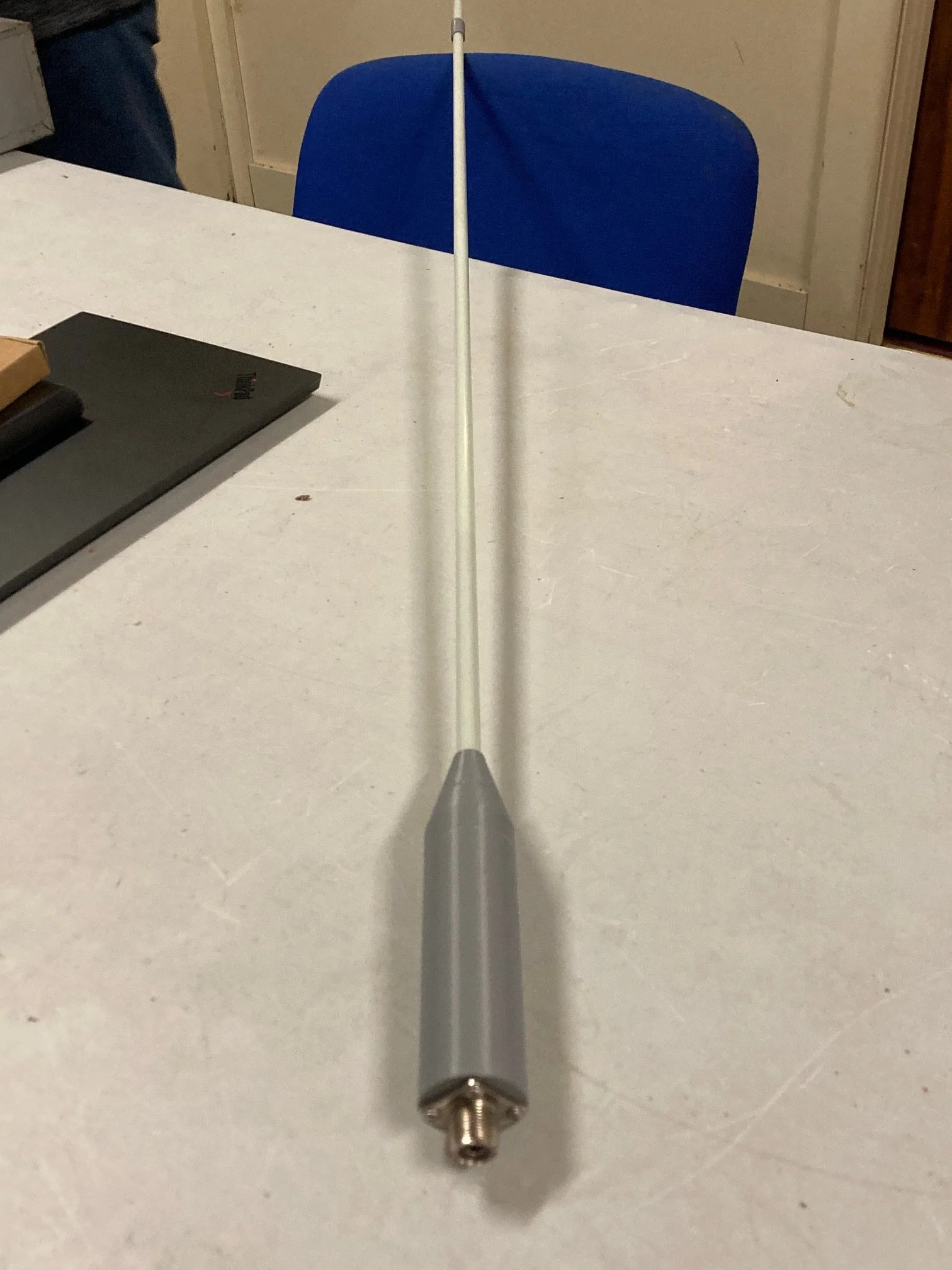
Colin, VK7ZCF, brought along a newly constructed dual‑band coaxial antenna he has been experimenting with. The design is based on a guide published by Frank Bremer, PA0FBK, for a 2 m / 70 cm antenna made entirely from RG‑58 coaxial cable. It states that “In principle, it is a variant of a J‑pole antenna and reportedly provides a good match to 50 Ω on both bands.”
Visually, the main element resembles a coaxial collinear, with every second braid section removed to form the radiating segments. A tuning stub, essentially a shorted length of coax shorted at the end, is also connected in parallel with the feed point to help achieve proper resonance. Colin’s finished antenna is approximately 1200 mm long, with the radiating section running up the 6 mm internal bore of a 10 mm fibreglass tube. Because the fibreglass rod was only available in 1 metre lengths, Colin 3D printed a joiner so he could add an extra section of tube. He also printed a base assembly to house the tuning stub and provide a mounting point for the SO‑239 RF connector. It will be interesting to see how Colin’s version of this unusual design performs once it is frequency swept for its performance.
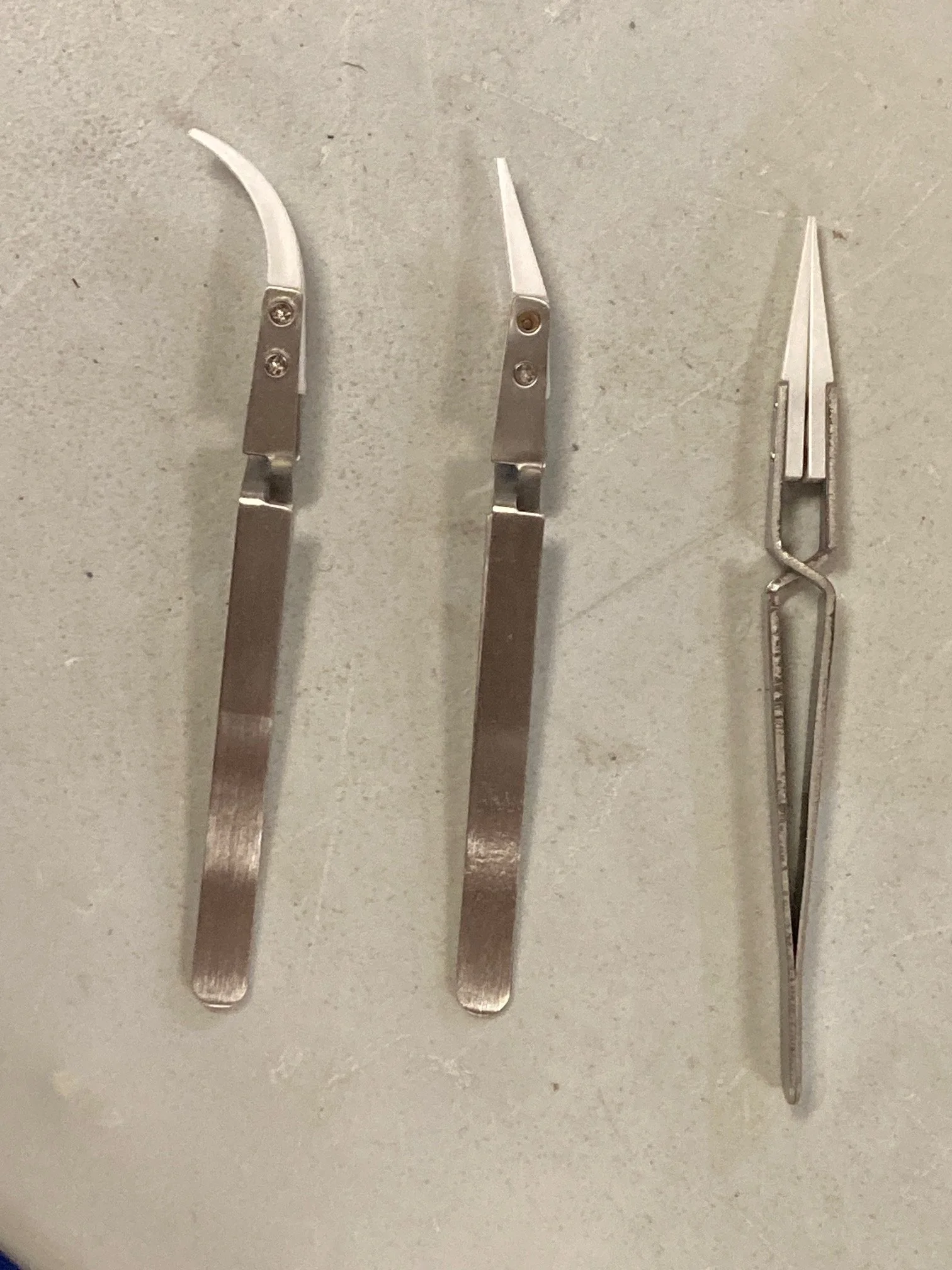
Now here’s one for the toolbox. Colin also brought along a set of three 120 mm long‑nose tweezers, available in straight, offset, and curved jaw styles. These are reverse-action tweezers often called cross-over spring tweezers, meaning you squeeze to open them and release to close and hold.
They feature robust stainless‑steel handles fitted with anti‑static, high‑temperature ceramic jaws. The jaws are screwed on, making them easy to replace when needed. This design also makes them ideal for holding some components during soldering, as the ceramic tips don’t wick heat away from the joint.
They’re very similar to the German‑made Knipex versions, but without the $100‑plus price tag per tweezer.
If you follow the Club Discord, you may have noticed a post in #building‑testing by Hayden, VK7HH. Over the past month he has been assembling a MeshCore repeater, and with the assistance of Nic, VK7NIC, the pair headed up Mt Arthur to install it on top of the old "Way-FM" wind‑turbine tower last weekend. The repeater is now operational and with luck, this will mark the beginning of a North-South mesh link, early days but promising.
I encourage readers to watch the video Hayden posted on his Ham Radio DX YouTube channel. It provides an excellent look at what members physically endure when carrying out any kind of work on Mt Arthur in support of amateur radio. I understand there may also have been time for a SOTA activation and a few QSOs. Whether that was the main mission, the excuse, or simply a reward for the spectacular views is left to your imagination, hi‑hi.
Text version: Hayden and Nic up Mt. Arthur - https://www.youtube.com/watch?v=uIIhBMTs4y0
While we are on the subject of MeshCore, let’s have an update on the happenings for the greater Launceston region, including some very interesting experimentation on the mainland.
With the latest software release, 1.15 there is a new pre-set of Australia Mid (medium) that addresses the limited range and minimises some of the LoRa interference issues. This may help locally as Launceston was an early adopter and is a heavy user of LoRaWAN IoT technology, therefore it is time to experiment again.
After all that’s what the hobby is all about. So in the coming weeks we will be trialling the various Australian pre-set bandwidth modes on some of the repeaters and companions. This will give a direct A-B comparison of the RF links using the same hardware.
After initial Test and Measurement, over the past few days, we have noted the following not insignificant differences:
An excellent increase in range for Narrow Band users and no loss of range for Wide band users
A tangible improvement in signal to noise ratio and random de-sensitisation
Also a much quicker "user feel" and faster messaging
Watch this space for further updates and if you are interested, check the links in the text version of this broadcast.
Text version:
Testing in NSW go to this link, https://zindello.com.au/well-that-was-something/
For an in-depth technical analysis go to this link, https://zindello.com.au/finding-the-sweet-spot-meshcore-lora-settings-in-the-australian-900mhz-band/
As usual pictures will be available on the NTARC Web site under “Blogs” for this broadcast. NTARC Blogs
UPCOMING EVENTS
On Air Test and Technical Net session - Every Wednesday night, Test-Net and CW course on 3.580 MHz
from 7 pm, then a Technical Net on 3.567 MHz from 7.30 pm till 8.30 pm. Your host for the evening is Nic, VK7WW.
Club Room Technical night - The next session will be this Wednesday the 27th May and will commence at the usual time of 6.30 pm at the Club Room Archer Street, Rocherlea.
Coffee Morning - Held every Friday in the NTARC Club rooms. Time is from 10 am to noon.
Finally - If you have any items of news please email them to the Secretary at the following address news@ntarc.net all items to be received no later than 5 pm on the Friday prior to the Broadcast.
That’s all folks,
73, Stefan VK7ZSB.