Broadcast - 7 June 2026
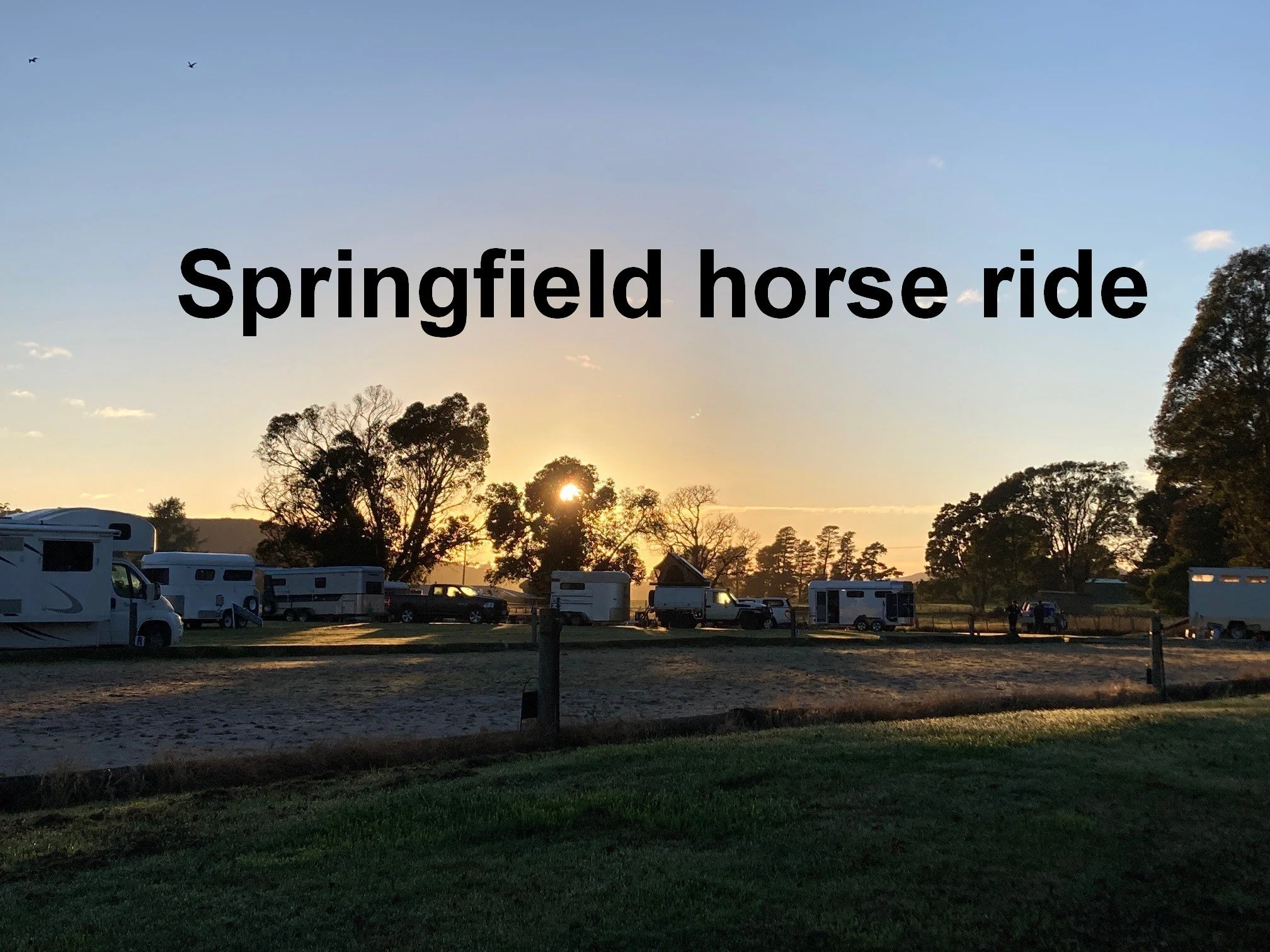
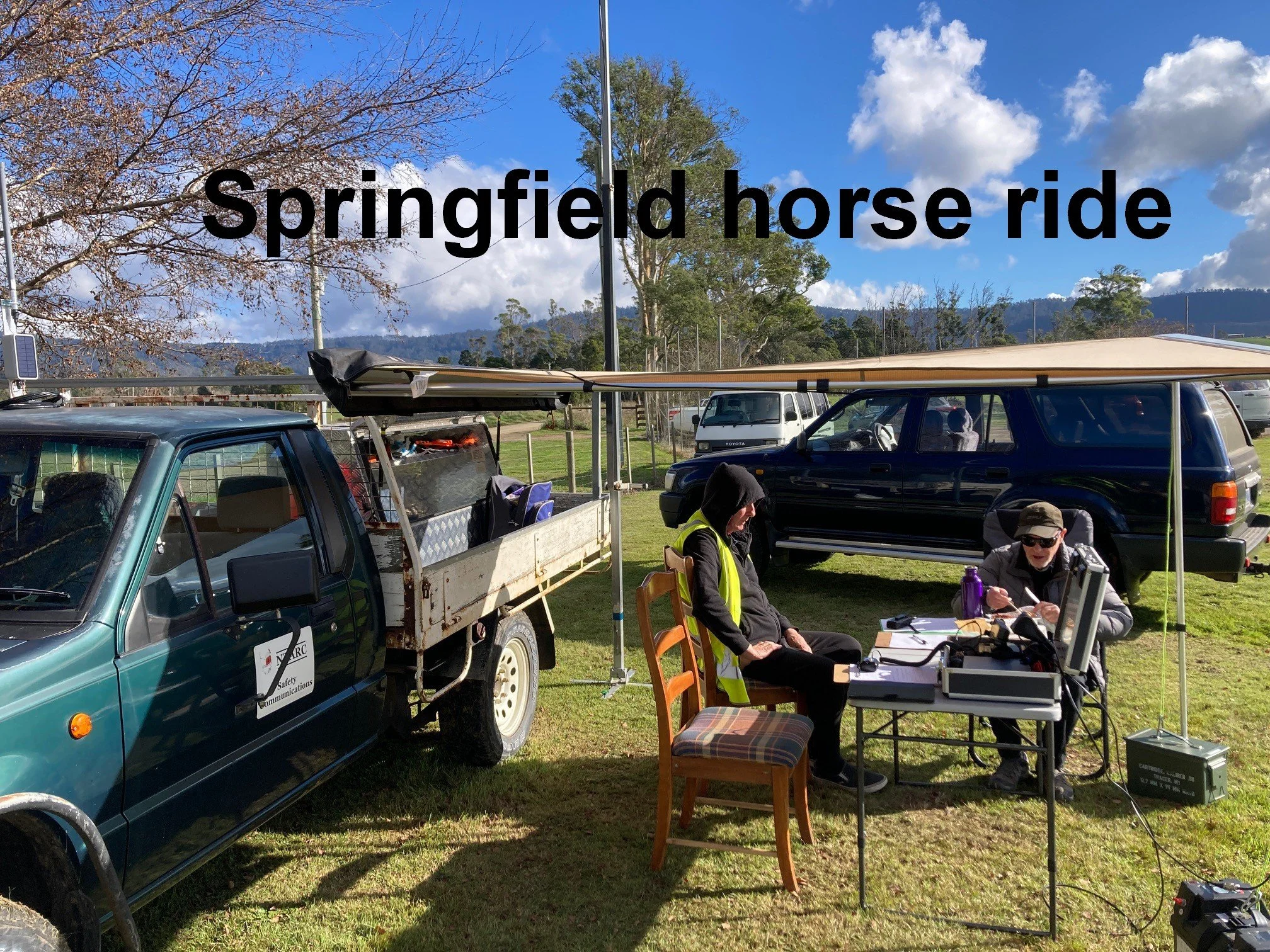
The first item is a quick update on NTARC providing safety communications and rider tracking at an Equine Endurance ride held at Springfield last weekend. No electronic tracking was employed so everything relied on 2 Metre voice communications, and good old paper. All the contingency had assembled by 6 am Saturday morning and were heading out to the checkpoints for the start of the 80 kilometre event at 6:30 am. Ride Base was staffed by VK7's André ZAB and Stuart ES. Checkpoints were operated by Tony ZTT, Idris ZIR, and Stefan ZSB, with additional support from Harry HXT and Xavier XHJ of REAST / WICEN, along with Pete from the Ulverstone Radio Operators Club. Another round of excellently coordinated safety logistics was delivered by Roger ARN.
The weather was indeed good to us with only light drizzle but a very chilly breeze. Rumour has it the sun made a cameo appearance, though witnesses remain unverified. Operationally the day went smoothly without any horse or rider mishaps. Thank you to all who assisted in the running of the communications side of this event.
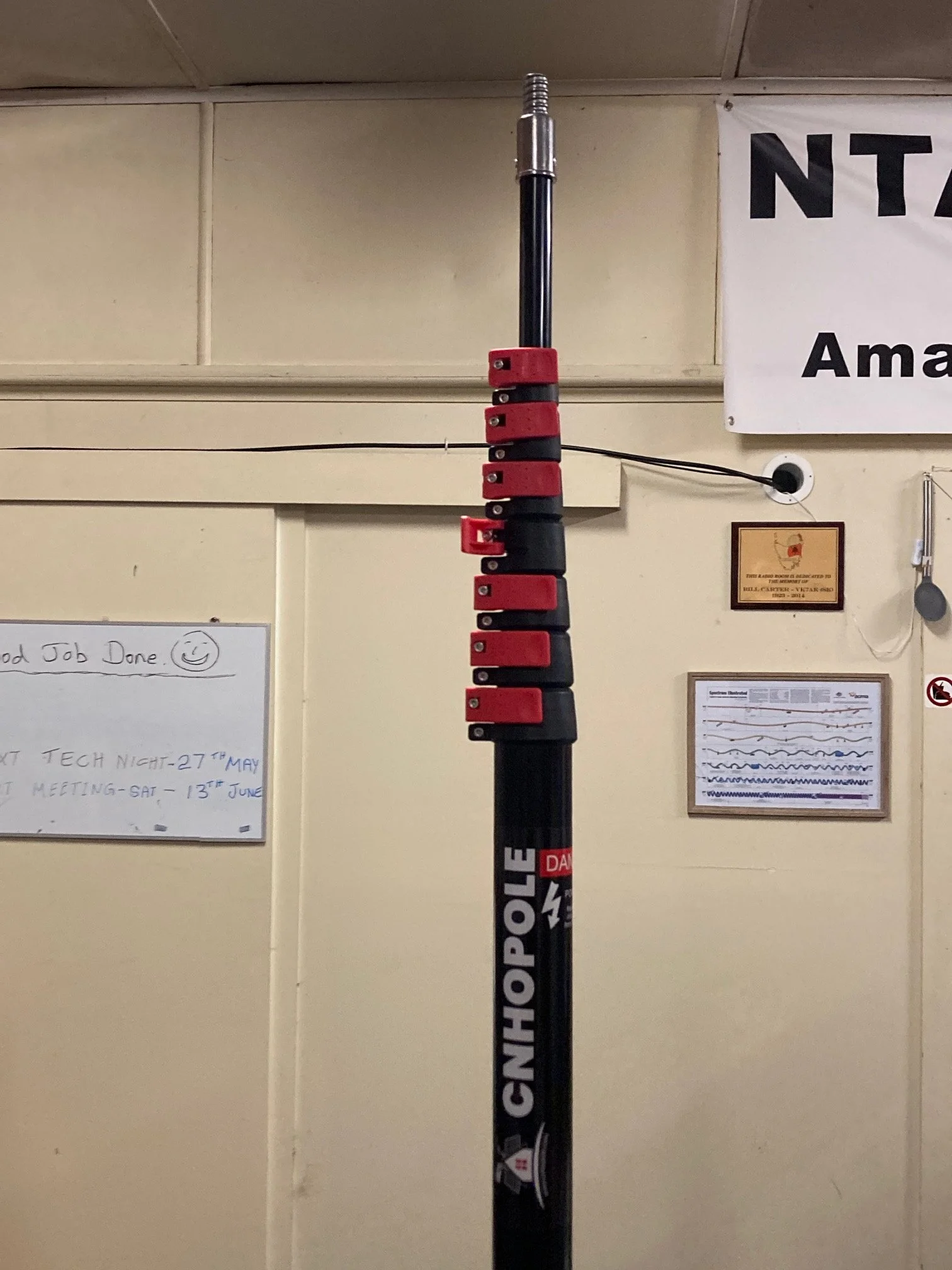
Now back to last technical night, Colin VK7ZCF had with him a telescopic 40 foot or about 12.2 metre aluminium pole. It’s called a "CNHOPOLE"… honestly, where do they get these names, and how is anyone meant to pronounce that. Their web site states "Whether you’re cleaning high-rise windows or painting high walls, it’s ruggedly built with high-strength materials for load-bearing capacity and durability." Funnily enough the sales material didn't mention that it was eminently suitable as a portable antenna mast, I wonder why, Hi-Hi. Individual sections are not the usual friction extended-hold found with fiberglass but each section incorporated a cam locking device. It seems to have less flex than a standard telescopic squid pole, but as it was raining we were only able to extend it by a couple of sections within the club rooms. As it is aluminium in construction, I would definitely take heed of the Danger Electrocution warning printed on the side.
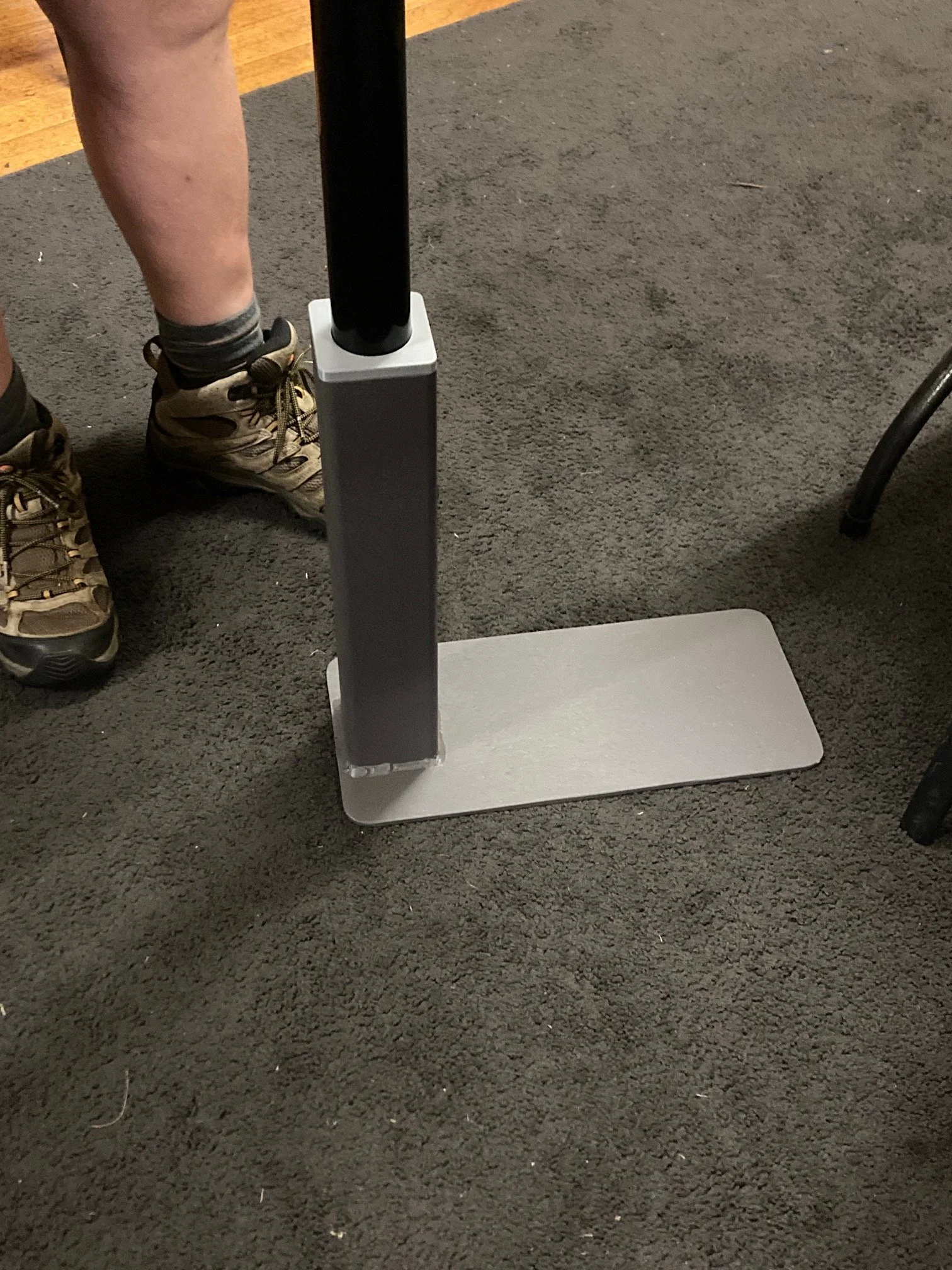
To complete the setup, Colin decided he needed a new drive onto, under car wheel, base plate and stand to support the pole when out and about. As the ground mount was a vertical square section receptacle, Colin 3D printed three friction fit bushes to go into the square section that adapted to the circular pole profile. Nice bit of engineering Colin.
As the pole comes standard with a male paint roller thread fitted, it will be interesting to see what else Colin 3D prints for easy attachment in the near future.
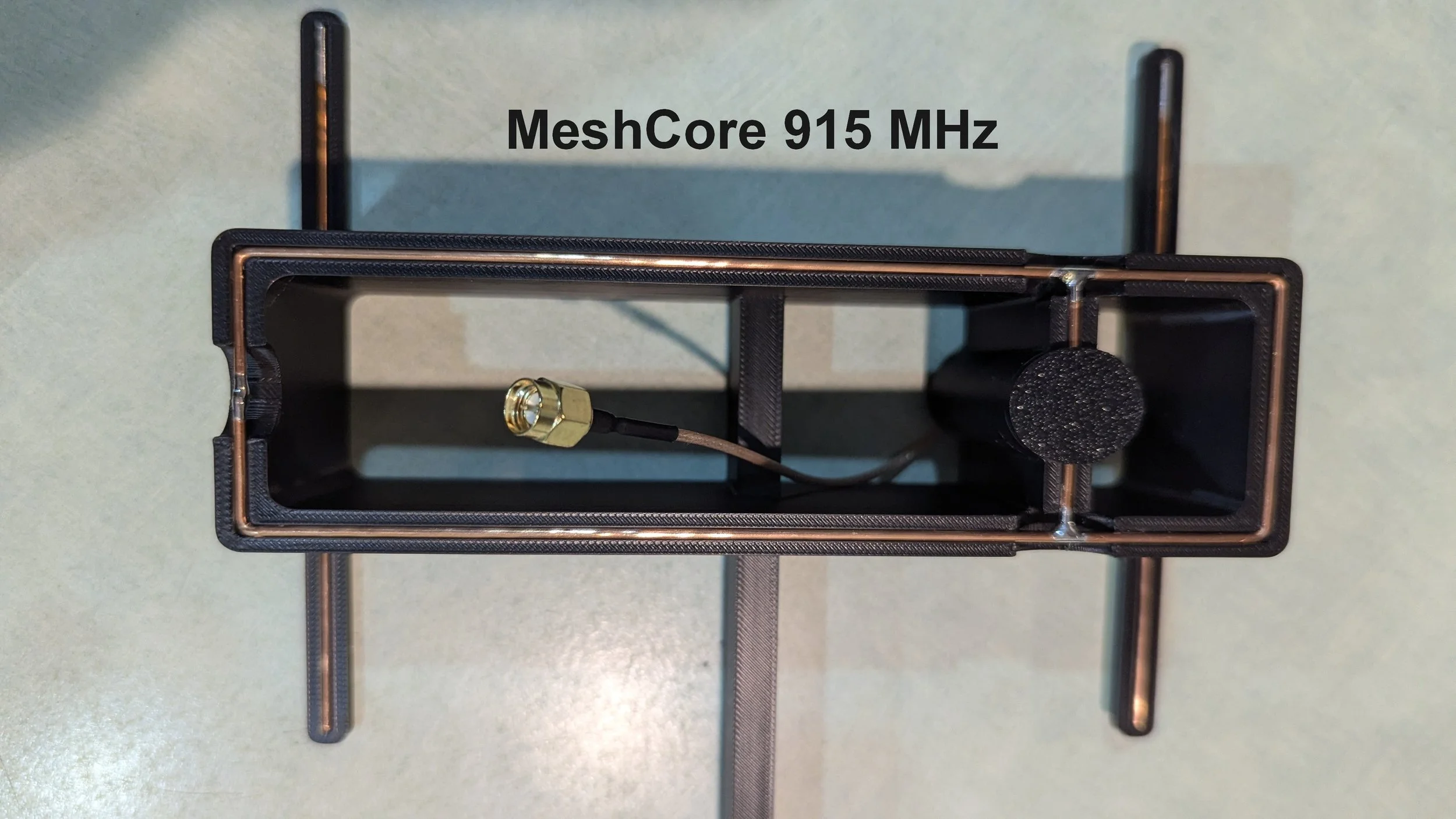
Now, going from one extreme to the other in terms of size, this next one is a very small antenna. Be honest…. how many of you have ever heard of a Quadlong Hentenna? I’m fairly sure that name has never crossed my path. Well, Tony, VK7ZTT, brought one along to last technical night. It’s based on the Martin Steyer DK7ZB scaled design for 915 MHz, but turned sideways to give vertical polarisation. The core structure of the Quadlong Hentenna is a 1.5‑wavelength extended quad, which gives it that stretched, oblong look. Its small size makes it perfect for 3D printing the entire frame, right down to a pistol grip handle. The clever part of this version is that all the driven elements and reflectors can be cut to length and simply laid into the printed trenches. Wherever a join is needed, a hollow section is built in so the soldering can be done without melting the plastic frame. On testing, the resultant frequency sweep returned an excellent centring on the designed frequency. The result is a quick, tidy, and very easy to build directional antenna.
For more information on 3D printing the frame and construction check out the link in the text version of this broadcast: https://www.printables.com/model/1564454-meshcoremeshtastic-antenna-915-mhz
For a deeper dive into the concept of the Hentenna or The Japanese 'Miracle' Wire, check out QST 1982 and in the ARRL – Antenna - Compendium, Vol. 5. Tony’s directional antenna makes an excellent seque, (pronounced seg-way), as it wasn’t designed for an amateur band, but for experimenting in a section of the Low Interference Potential Devices band or the LIPD band, and centred on 915 MHz for the use of MeshCore.
As mentioned previously, switching the configuration to Australian Mid for comparison testing delivered improvements in speed, with no noticeable loss of range, which is an important aspect. Judging by the tsunami of operators who have already made the change, the point is probably academic now. We are however recommending the use of two byte path addressing to minimise node address clashing. But of course, it’s entirely up to each operator to choose whatever setting best suits their own situation.
As usual pictures will be available on the NTARC Web site under “Blogs” for this broadcast. NTARC Blogs
UPCOMING EVENTS
On Air Test and Technical Net session - Every Wednesday night, Test-Net and CW course on 3.580 MHz from 7 pm, then a Technical Net on 3.567 MHz from 7.30 pm till 8.30 pm. Your host for the evening is Nic, VK7WW.
Club Room Technical night - The next session will be Wednesday the 10th June and will commence at the usual time of 6.30 pm at the Club Room Archer Street, Rocherlea.
Club General Meeting - Saturday 13th. June at 2:00 pm. Held at the NTARC Club Room, Rocherlea Scout Hall, Archer Street, Rocherlea. If you have items you would like added to the agenda please email the secretary at: secretary@ntarc.net no later than Friday the 12th June.
Coffee Morning - Held every Friday in the NTARC Club rooms. Time is from 10 am to noon.
Finally - If you have any items of news please email them to the Secretary at the following address
news@ntarc.net all items to be received no later than 5 pm on the Friday prior to the Broadcast.
That’s all folks,
73, Stefan VK7ZSB.