Broadcast - 9 August 2026
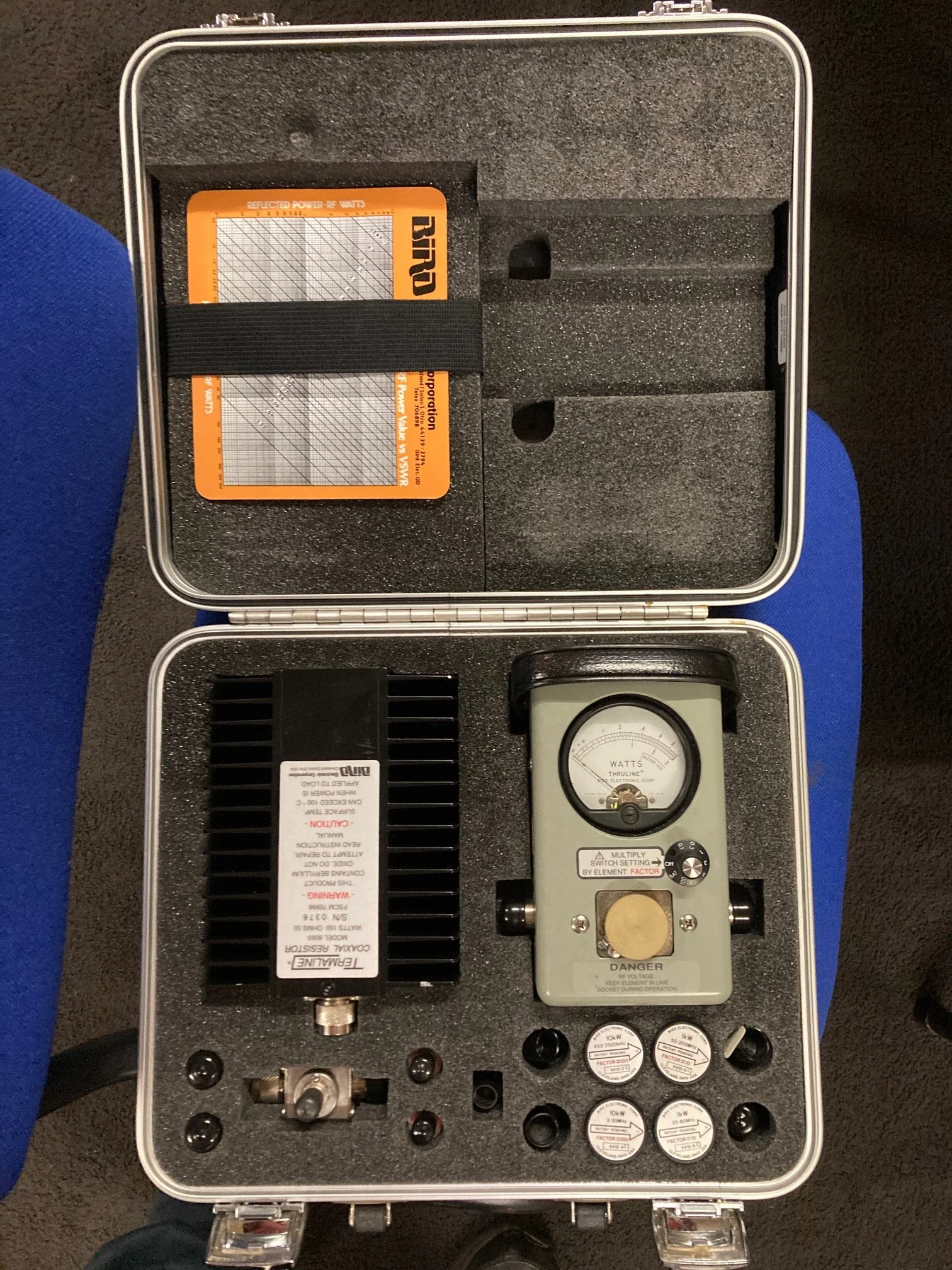
Colin VK7ZCF brought along a new.... well, new to him, Bird Technologies Thruline RF Directional Wattmeter to this week’s club Technical Night. Just mentioning the name Bird instantly conjures up its iconic image for many of us. It must be one of the most recognisable instruments in radio engineering.
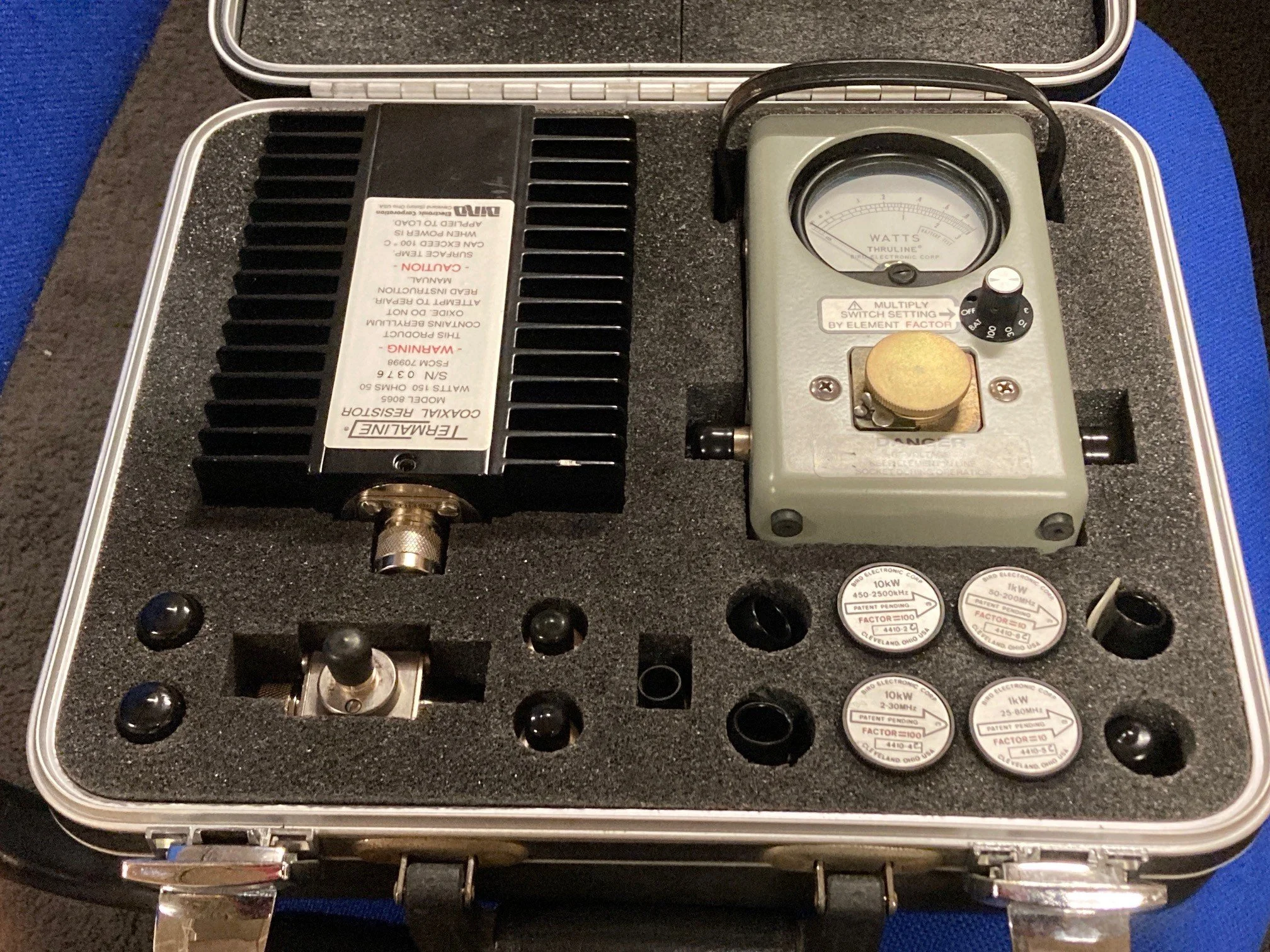
The unit is classic Bird: a solid rectangular die‑cast enclosure, a sloping front panel with a round meter at the top, and a plug-in element, the famous “slug”, toward the bottom. A black leather carry handle runs across the top, and there’s an N-type connector on each side of the case. Pure simplicity.
The slug’s proper name is the APM or Average Power Measurement element, but in the industry, it’s almost universally called a slug. The circular plug-in element is about the size and shape of a 35 mm film canister... now I’m admitting my age, hi-hi. Each APM element is selected and purchased individually for the required frequency range and power level. A typical example might be labelled 100 to 250 MHz at 250 W. In Colin’s case he can cover 25 to 200 Mega Hertz up to 1 kilowatt with two elements and from 450 kilo Hertz to 30 Mega Hertz up to 10 kilowatt with two others. Once inserted, the element can be rotated through 180 degrees, one position for Forward Power, and rotated the other way to measure Reflected Power. A laminated chart of forward versus reflected power provides the all‑important VSWR.
This functionality stems from Bird’s directional “Thruline” patent granted in 1958, this patent underpins this famous Bird Model 43 range. Colin’s meter is a later version, incorporating a multi‑position control switch for power off, battery test, and one of seven meter-scale “element factor multipliers” specific to the slug in use.
The unit came complete with its own rugged carry case, with cut-outs for each item. Colin’s kit also includes a Bird Termaline Coaxial Resistor, rated at 150 W and 50 ohms, better known as a dummy load. It even carries a Beryllium Oxide warning on the label, so best not to open it up.
These instruments have never come with a cheap price tag, but for serious RF measurements they are serious pieces of test equipment, and if looked after, they’ll last practically forever.
True to our promise, this week we managed to cover the short presentation from Wade VK4WM. Wade briefly covered Britain’s retiring BBC Radio 4 long wave transmitters at sites like Droitwich, Westerglen and Burghead all falling silent. Citing ageing infrastructure, high costs, and changing technology. Followed by the majority of the presentation based around something quite different in North Queensland near the township of Brandon, where a medium wave transmitter site has been rebuilt. He covered the “dropping” of a magnificent piece of broadcast history: a 198 metre capacitive top-hat antenna constructed in 1959. As sad as it is to watch a tower or antenna come down, in this case it was necessary so the site could be modernised. The ABC’s 4QN broadcast station’s 630 kHz AM transmitter, running 50,000 watts, is now coupled to a brand new 236 metre vertical radiating element. It is providing a service with coverage across North Queensland via ground-wave propagation.
Brandon was also the site of a major Radio Australia shortwave transmitting station. Its curtain arrays were engineered to throw powerful signals toward Papua New Guinea and across the Pacific as well as Australia’s interior, using the ionosphere to carry shortwave broadcasts thousands of kilometres. Together, these facilities formed an extraordinary broadcasting asset for Australia.
This video presentation from Wade can be summed up in his own words “Broadcasting infrastructure is not obsolete just because it’s old. Sometimes old technology survives for one very simple reason. It still does the job.”
Thank you Stuart VK7ES, for bringing this Australian finding to our attention. The link to the item is included in the text version of the broadcast: BBC Longwave shutdown - Australian Rebuild
From the completion of the presentation Lionel VK7ZLB, took us through other major antenna installations around Australia, like the Omega navigation tower, operating at 10–14 kHz, located near Sale in Victoria. Built at the Bass Strait Radio Station site in Fulham, it stood over 400 metres tall and was part of the global Omega VLF navigation network. It operated from the early 1980s until the system was shut down in 1997, after which the tower was demolished.
We can hopefully look forward to a more comprehensive presentation on these types of installations once Lionel can find the 35mm slides. Hi-Hi
As usual pictures will be available on the NTARC Web site under “Blogs” for this broadcast. NTARC Blogs
UPCOMING EVENTS
CW course - Every Wednesday night, on 3.580 MHz from 7 to 7.30 pm. Your CW Coach for the evening is Nic, VK7WW.
On Air Test and Technical gathering - Wednesday nights, on 3.567 MHz from 7.30 pm.
Club Room Technical night - The next session will be Wednesday the 19th August and will commence at the usual time of 6.30 pm at the Club Room Archer Street, Rocherlea.
Coffee Morning - Held every Friday in the NTARC Club rooms. Time is from 10 am to noon.
Finally - If you have any items of news please email them to the Secretary at the following address news@ntarc.net all items to be received no later than 5 pm on the Friday prior to the Broadcast.
That’s all folks,
73, Stefan VK7ZSB.